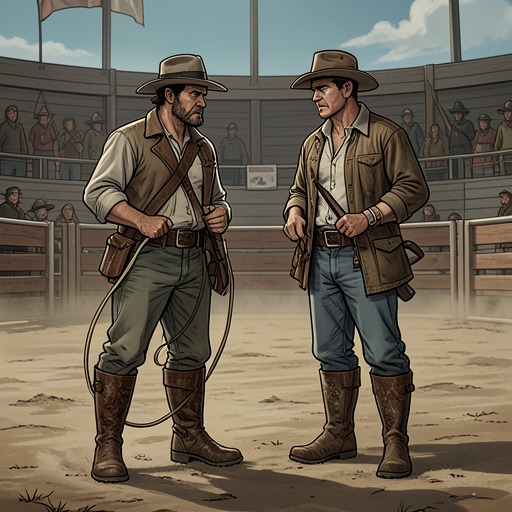
Polk's Cow Stadium
Cry MachoPolk’s Cow Stadium is both a working rodeo venue and the stage on which Mike Milo’s public identity as a cowboy star is built and tested. Its history traces a change from a financially failing arena to a tightly managed, crowd-drawing show, while its performances expose the distance between the heroic cowboy image and the vulnerable man required to embody it.
Setting and institutional history
The stadium presents itself to arriving crowds through spectacle. A huge banner in shiny psychedelic silks directs attention from the parking lot to two entry arcades, between which hangs a full-length photograph of Mike on a rearing bronc, hat aloft and face set in a fixed, plastic grin. The image advertises the show, but it also preserves a version of Mike that he has trained himself not to notice: it was taken before he came to the stadium, during a difficult final year of competition marked by injuries, poor earnings, sleeplessness, and drinking.
The arena began as a troubled business. The Macmillan Brothers owned a stadium too large for its small town, and the major cities drew away the major rodeos. Attractions came too irregularly to establish a dependable audience, leaving the venue in decline. Carly, the oldest brother, proposed creating a resident rodeo company. The plan gave the stadium a regular show, but the company collapsed eighteen months after Mike became a salaried rider. The arena then passed into the hands of its mortgage holder, Howard Polk.
Polk’s management and the changed show
Polk’s arrival altered both the stadium’s fortunes and its working culture. He was an outsider to rodeo practice, unfamiliar with its vocabulary and liable to use terms the cowboys considered wrong. Yet within two years, performances took place every night except Monday. The turnaround did not win the riders’ affection. Polk challenged their preferred image of themselves as cowboy heroes and National Finals contenders: because they remained on salary rather than competing on the circuit, he regarded them as actors in a managed attraction. To the men, this recasting made the stadium feel less like a proving ground and more like a theater.
The new order became tangible in a rule requiring the cowpunchers to sign an attendance ledger every half hour. The men resented the requirement but complied. Mike did not object openly; he simply never signed. The stadium therefore became a site of quiet resistance as well as employment, and Mike’s defiance foreshadowed the friction between his independence and Polk’s control.
The Ride-Out and commercial spectacle
Mike helped create the event that gave the show a distinctive climax. The rodeo had not quite succeeded, and he suggested a heart-stopping feature: instead of ending a ride at the standard eight-second bareback or ten-second saddle-bronc limit, a cowboy would stay on until he was thrown or the horse went quiet. The idea became the Ride-Out, presented as a special event. Its novelty attracted press coverage and crowds; placed at the end of the program, it sent audiences away shouting and restored Mike’s status as a star.
Polk later moved an additional Ride-Out to the opening portion of the program to strengthen its start, then increased the danger by providing fresh broncs that were not the relatively manageable animals Mike had originally proposed. The stadium’s success thus depended not only on Mike’s skill but on raising the risk for the sake of excitement. The change made the event an especially clear expression of the venue’s double character: a polished attraction for paying spectators and a physically demanding contest for its performer.
Mike’s performance and its cost
The stadium’s public address system introduces Mike by his accumulated credentials: three National Finals wins, the Dallas Buckle for bareback riding, and nine Cattlemen Trophies. He rides Tabasco before a cheering audience, then performs the signature flourish spectators expect, tossing his white hat into the air and catching it. The gesture turns a display of riding into a rehearsed image of effortless mastery, even as Mike is already challenging the pain he expects to follow.
As he turns toward the catch pens to leave, Tabasco rears and throws him. Mike is unable to rise immediately, and the horse tramples him before other riders and arena workers rush in. He eventually gets to his feet, searches for his hat, and waves it to reassure the crowd. The audience answers his effort with an intense display of affection. The moment binds the stadium’s spectacle to its cost: the crowd sees apparent courage and recovery, while the scene makes clear that its beloved star has been hurt and is trying to preserve the performance even afterward.
Return, departure, and significance
Four weeks after the cast is removed, Mike walks back toward the stadium still limping. He tries to conceal the limp on the way to Polk’s office, wary of being read as an aging rider whose body no longer recovers as it once did. The contrast with his younger self is pointed: at nineteen, he had wanted a dramatic limp to advertise his grit; now he believes that showing it would advertise decline. Though his arm pain has eased after injections, dizziness remains. The stadium’s work continues around him on Monday, its usual day off, while maintenance and repairs fill the corridor.
Later, Mike returns to the stadium around dinnertime to empty his locker. In the dark tackroom, he throws away his rigging gear, show clothes, hat, boots, and other belongings, along with a magazine bearing his picture on the cover. He tears down an earlier photograph of himself and puts away his awards, buckles, trophies, and ribbons. The act gives the stadium a final role in his rodeo career: it is not merely the workplace he leaves, but the storehouse of the costume, publicity, and honors through which his cowboy identity had been maintained.
The venue also belongs to a wider world of arenas in which people and animals are made to perform toughness for an audience. At a cockfight elsewhere, Mike recognizes the same appeal of violent spectacle that had accompanied his own arena career, and grieves that the arenas had claimed the first half of his life while he would still gladly give them the rest. That reflection sharpens the significance of Polk’s Cow Stadium. Its crowds, banner, and celebrated events make the cowboy hero visible, but its ledger, commercial calculations, bodily risks, and Mike’s discarded trophies reveal the labor and vulnerability concealed by the image.